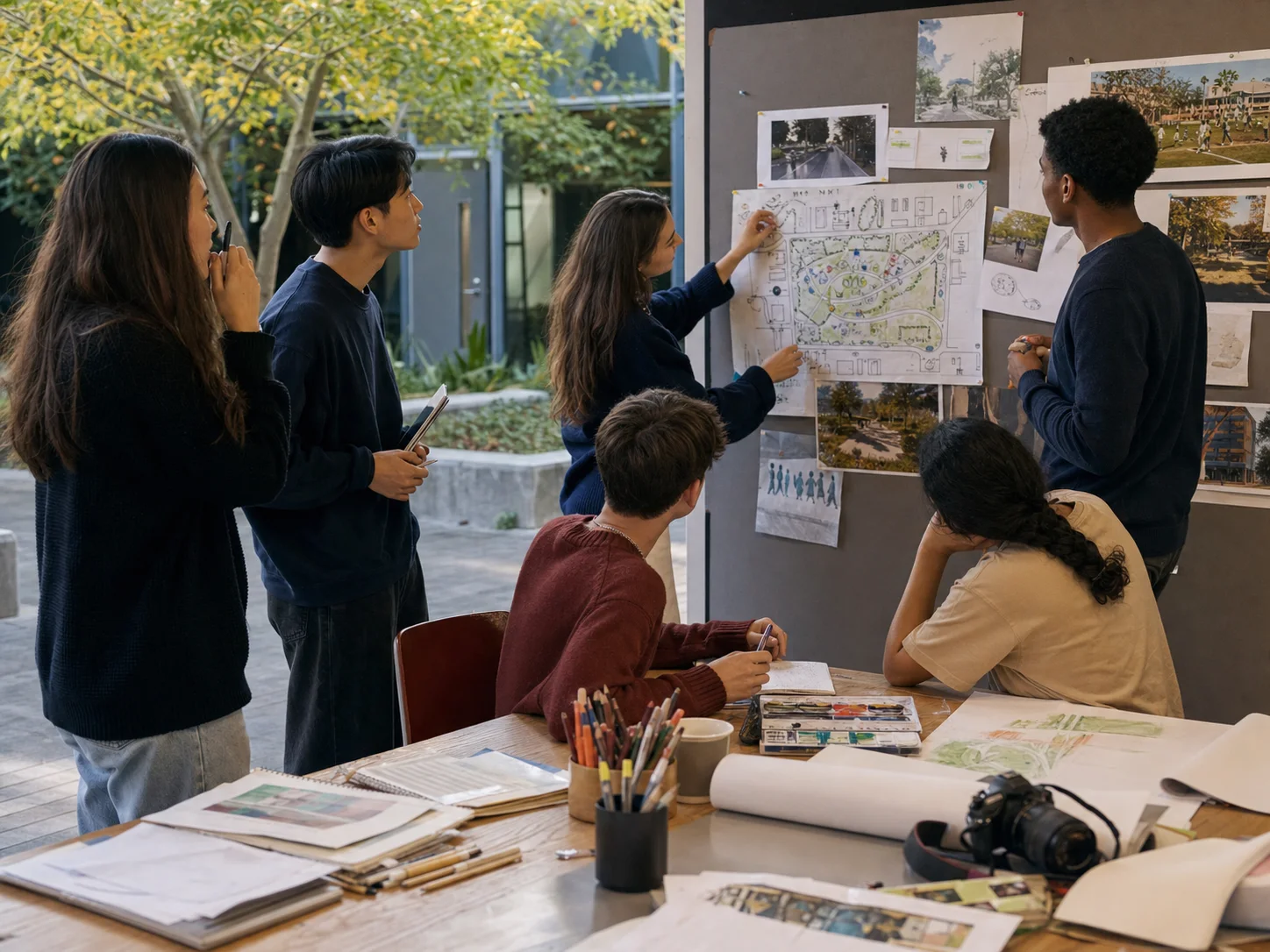

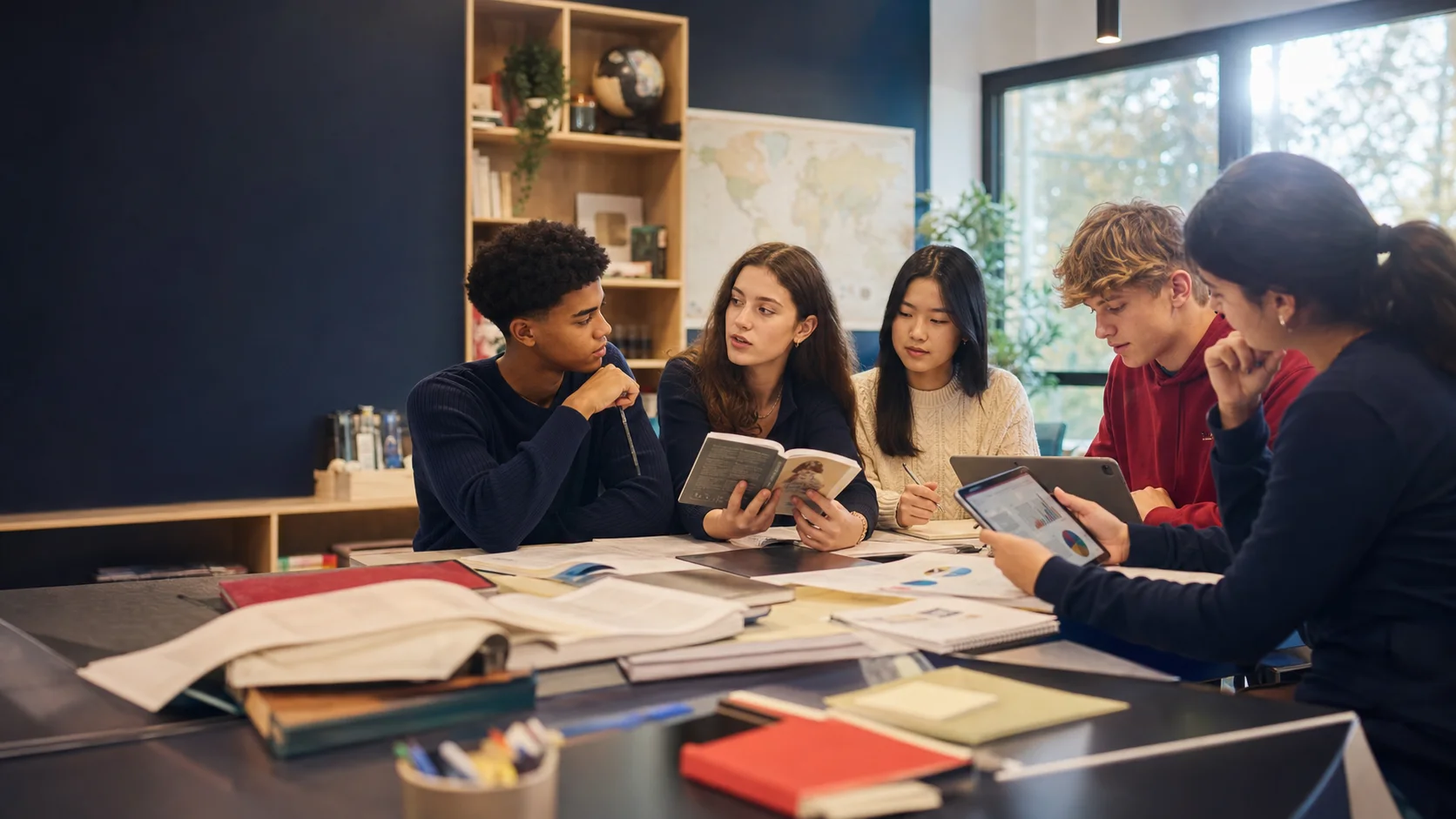
High school students collaborating on an interdisciplinary project
IB World School
International Baccalaureate

International Baccalaureate

Geneva Christian School is an IB World School authorized to offer the International Baccalaureate (IB) through the Diploma Programme (DP).

We are committed to forming compassionate, curious, and critical thinkers who are prepared to contribute to a better world.

Students planning a creative community impact project

1968

Year the International Baccalaureate Organization was founded.

Education for a complex world

What is the International Baccalaureate?

Founded in 1968, the International Baccalaureate Organization (IBO) is a global nonprofit organization headquartered in Geneva, Switzerland, offering rigorous and comprehensive educational programs for students of different ages.

The IB is widely recognized for promoting an international education that combines academic excellence, personal skill development, and a global mindset.

Its mission is to develop curious, reflective, and responsible young people who can face the complex challenges of the modern world with knowledge, ethics, and empathy.

Critical thinking

Analyze, question, and build new perspectives.
Global mindset

Understand cultures and act responsibly.

Whole-person education

Unite knowledge, ethics, empathy, and initiative.

IB at Geneva Christian School

A global education, driven by purpose.

Geneva Christian School proudly reaffirms its mission to prepare students for a globalized future as Brazil’s first Protestant IB World School.

The Diploma Programme (DP) is the centerpiece of our IB offering for high school. It provides a balanced and comprehensive education that equips students to think critically and understand different cultures.

01

Academic rigor

A challenging curriculum recognized by universities around the world.

02

Student agency

Students investigate, argue, and take responsibility for their learning.

03

Interdisciplinarity

Connected knowledge for understanding real problems in depth.

04

Service and character

Learning that becomes thoughtful action in the community.

International Baccalaureate Diploma Programme logo

A global approach to High School.

The Diploma Programme (DP) is a two-year curriculum for students aged 16 to 19, widely recognized by universities worldwide for its academic rigor.

At Geneva Christian School the DP will be an essential part of the high school program, further strengthening our already robust educational offering.
2 years of study 6 subject groups 3 core components
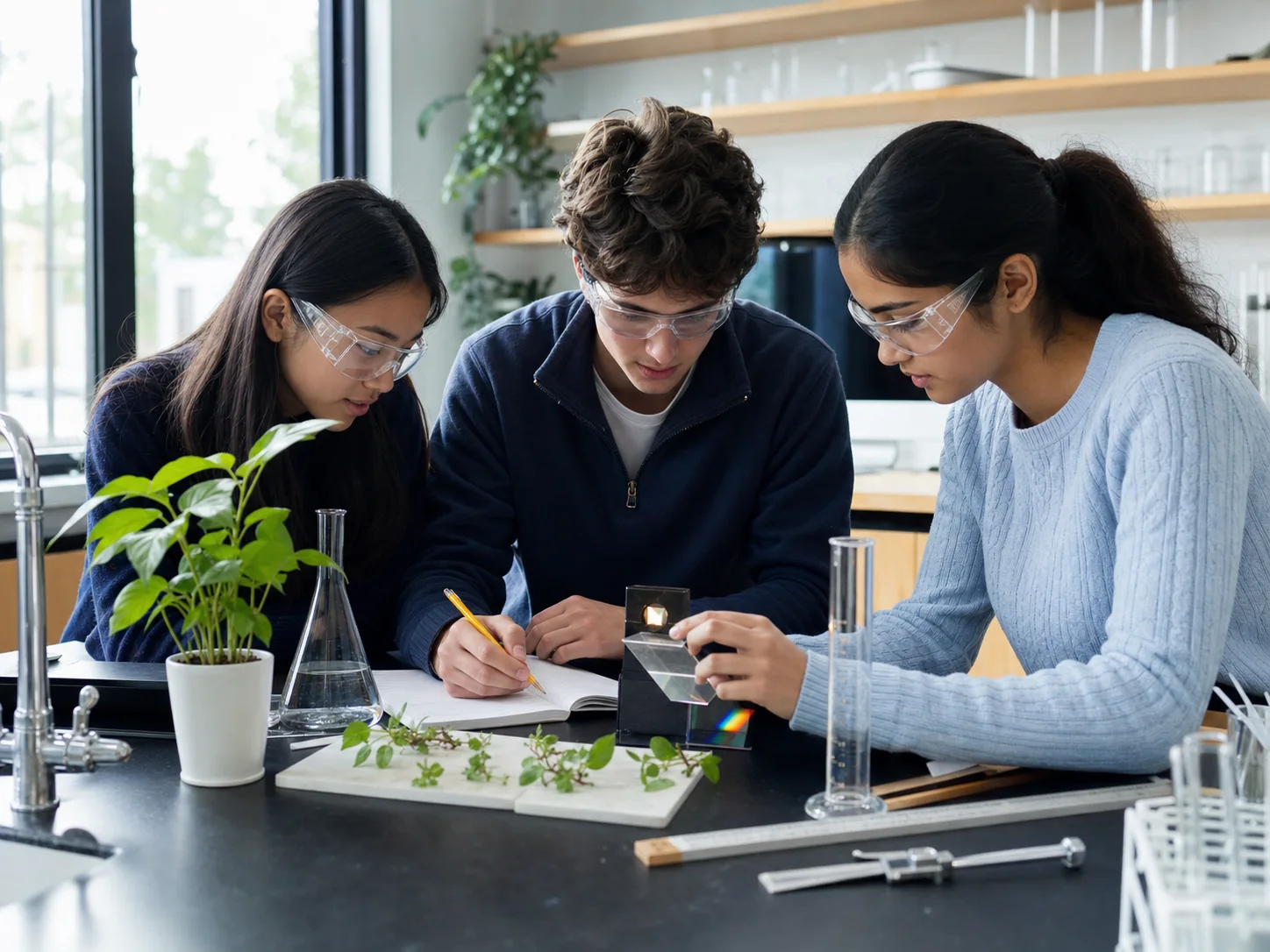
Students conducting a collaborative scientific investigation

Learning through inquiry

Concepts, evidence, and different perspectives connected to real-world problems.

DP Curriculum

Six areas of knowledge. One connected education.

The Diploma Programme at Geneva Christian School gives students the opportunity to study six subjects in depth across six main groups.

Students discussing literature and analyzing different texts
01 Required HL

Language and Literature

Language A: Language and Literature

Language, identity, culture, and the critical analysis of different forms of communication.

International Baccalaureate Diploma Programme logo

Language A: Language and Literature

Students study a wide range of literary and non-literary texts across different media. By examining communication in diverse literary forms and text types, together with appropriate secondary readings, they investigate the nature of language and how it shapes and is shaped by identity and culture.

Approaches are intentionally varied and may include literary theory, sociolinguistics, media studies, and critical discourse analysis.

This subject is taught in Portuguese and is a required Higher Level course.

Students practicing a second language in a collaborative activity
02 SL and HL

Language Acquisition

English B

Communication in varied contexts and a conceptual understanding of how language works.

International Baccalaureate Diploma Programme logo

English B (SL and HL)

Language B is designed for students with prior experience in the target language. Students further develop their ability to communicate by studying language, themes, and texts while building a conceptual understanding of how language works at the appropriate course level.

Difference between SL and HL

At both levels, students learn to communicate in familiar and unfamiliar contexts. They describe situations, narrate events, compare ideas, explain problems, and express and defend personal opinions on course-related topics.

The study of two literary works originally written in the target language is required only at HL. SL and HL also differ in the expected proficiency in receptive, productive, and interactive skills.

Students analyzing maps and data about different societies
03 SL and HL

Individuals and Societies

Business and Social Studies

Decision-making, societies, and Brazil’s role in a globally interconnected world.

International Baccalaureate Diploma Programme logo

Business Management – BM (SL and HL)

Business Management meets the current and future needs of students who want to expand their knowledge of business content, concepts, and tools for decision-making. Future employees, business leaders, entrepreneurs, and social entrepreneurs need confidence, creativity, and compassion as agents of change in an increasingly interconnected global market.

Through creativity, change, ethics, and sustainability, students examine business functions, management processes, and decision-making in contemporary contexts of strategic uncertainty.

Students investigate how internal and external factors influence business decisions and their impact on stakeholders, with emphasis on strategy and operations such as human resources, finance, accounting, marketing, and operations management.

Difference between BM SL and HL

SL and HL differ in recommended teaching hours, depth and breadth of extended content, and the nature of questions in Papers 2 and 3.

Paper 2 develops quantitative skills at both levels, with greater depth expected at HL.

Paper 3 is exclusive to HL and uses a social enterprise context in which students analyze a human need and organizational challenges before writing a decision-making document with a business recommendation.

Brazilian Social Studies – BSS (History and Geography) (SL)

Brazilian Social Studies covers eight topics across the geography and history of Brazil, providing a broad view of the country’s development and position as a regional power in the global economy.

The course explores physical, political, social, economic, religious, technological, and cultural aspects of Brazil through historical and geographical perspectives.

An international perspective highlights Brazil’s role in the region and the world. The subject is taught in Portuguese and provides the depth and breadth required for Brazilian university entrance examinations.

Students conducting a biology and physics investigation
04 SL and HL

Sciences

Biology and Physics

Experimental inquiry, scientific thinking, and an understanding of the natural world.

International Baccalaureate Diploma Programme logo

Biology (SL and HL)

The earliest evidence of life on Earth dates back at least 3.5 billion years. Through reproduction and natural selection, life has diversified into an extraordinary range of niches, making biology both fascinating and challenging.

Biological knowledge advances through improved techniques, pattern recognition, controlled experiments, and scientific collaboration. Form and function, unity and diversity, continuity and change, and interaction and interdependence shape the curriculum.

Physics (SL and HL)

Physics encompasses everything we do as human beings; the word itself means “the study of nature.” Like the universe, our knowledge of physics is constantly expanding.

Physics discoveries underpin technologies that transform everyday life, including communication, medical technology, and renewable energy.

Above all, physics is creative. It requires a strong grasp of fundamental principles, curiosity, and a willingness to test ideas in innovative ways.

Difference between SL and HL

SL and HL students share an engaging experimental program, the nature of science as a central theme, a concept-based curriculum, an internally assessed scientific investigation, and a collaborative sciences project.

SL provides a foundational understanding and associated skills, while HL requires deeper knowledge and offers a strong basis for future university study.

SL recommends 150 teaching hours and HL 240 hours. The distinction lies in both breadth and depth, with HL building more interconnected knowledge across the curriculum.

Students solving a mathematical modeling problem
05 SL

Mathematics

Applications and Interpretation

Modeling, technology, and mathematical problem-solving in real-world contexts.

International Baccalaureate Diploma Programme logo

Mathematics: Applications and Interpretation (SL)

This course recognizes the growing role of mathematics and technology in a data-rich world. It emphasizes mathematics in context through topics commonly used in applications and mathematical modeling.

The course includes algebra, functions, geometry, trigonometry, probability and statistics, and calculus.

It is designed for students who enjoy seeing mathematics used in real-world contexts and exploring connections with other subjects. Students use appropriate technology to apply mathematical knowledge to realistic problems.

It differs from Mathematics: Analysis and Approaches in its balance of theory and application and is intended for students more interested in the practical side of mathematics.

Students developing a scene during a theatre rehearsal
06 Optional SL

The Arts

Theatre

Research, creation, collaboration, and the communication of ideas through theatre.

International Baccalaureate Diploma Programme logo

Theatre (SL)

This is an optional group subject when a student completes the curriculum with six subjects from other groups.

IB Diploma Programme Theatre is a multifaceted theatre-making course that allows students to work as creators, designers, directors, and performers, both individually and collaboratively.

Students actively investigate, develop, present, and evaluate creative work, transforming ideas into action and communicating them to an audience.

Research and theory inform and contextualize practical, physical engagement throughout the course.

The course develops theatre and life skills, including confidence, imagination, creativity, and a collaborative mindset.

The programme core

Knowledge transformed into experience.

Alongside the subjects, the Diploma Programme includes three core components that are fundamental to each student’s whole-person education.

TOK

Theory of Knowledge

This course encourages students to reflect on the nature of knowledge, explore how we know what we know, and critically analyze different ways of knowing.

EE

Extended Essay

An independent, in-depth research project on a topic of interest that develops essential skills in inquiry, organization, and academic writing.

CAS

Creativity, Activity, Service

A practical component integrating creative extracurricular activities, sports, and community service to foster personal development and active community engagement.

Discover the programme

See how the Diploma Programme can expand your child’s future.

Contact our Concierge team to learn about the IB approach, curriculum, and experience at Geneva Christian School.
I want more information